
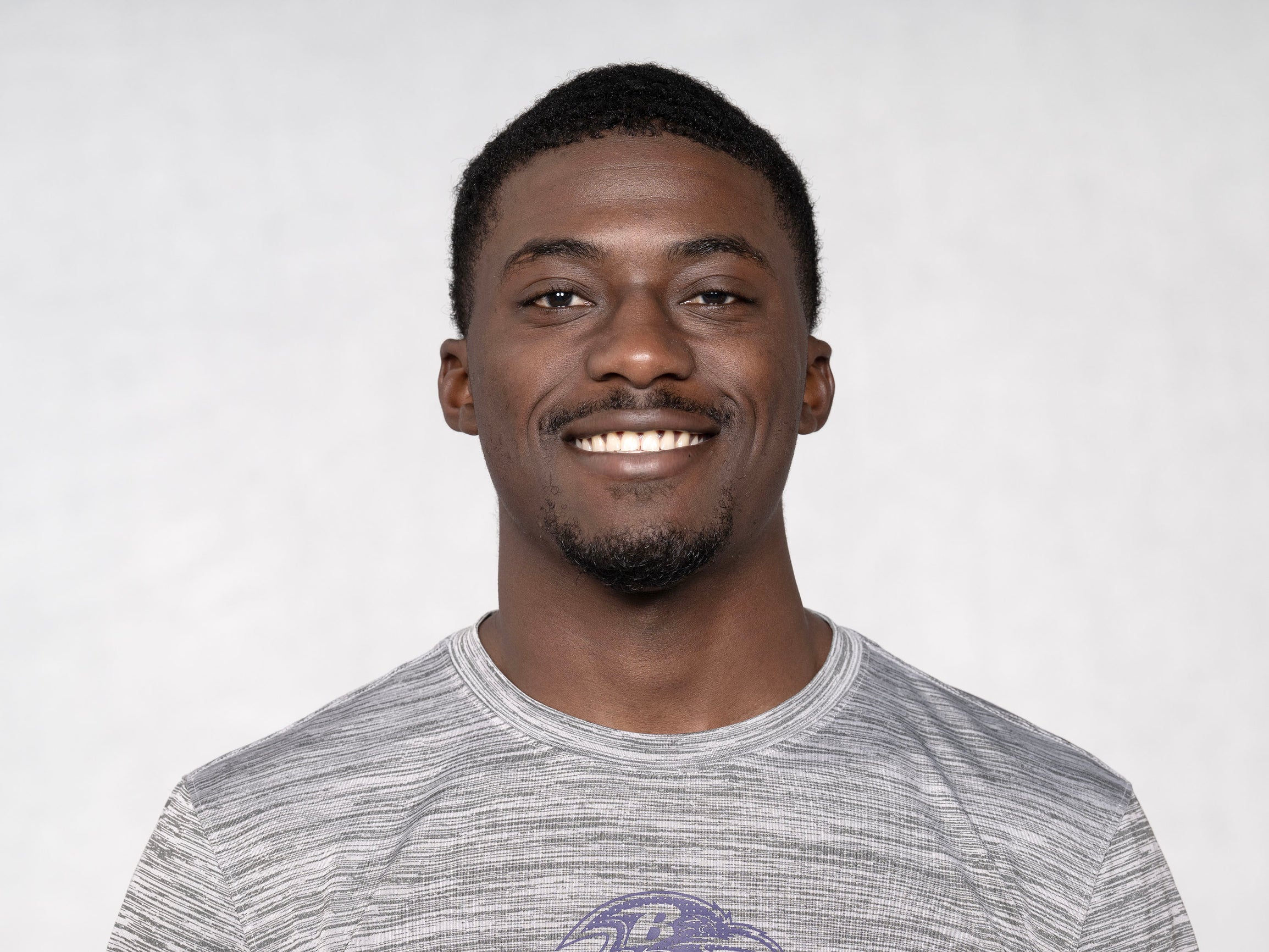
Former Rice football safety Peyton Stevenson '26 is bringing his on-field talents to central Maryland in his new role as a sports science fellow with the NFL's Baltimore Ravens.
Stevenson joined the Ravens in May of this year, and he has since settled into his new role as a part of the Ravens’s health and performance team.
“My role is pretty cool because I’m in the middle of a lot of moving parts,” Stevenson says. “It’s a culmination of the strength and conditioning, athletic training, and nutrition departments.”
A large part of Stevenson's role is leveraging the team’s cutting-edge technology to help players maximize their potential. This includes working with catapult units, which capture individual player tracking data to monitor player performance and health.
“We can keep up metabolically with how many yards they ran or how fast they're running,” Stevenson says. “That helps them get as good as they can be in the off season, and it also establishes a baseline. Then if they get injured, we can say, 'How do we get you back to that baseline?'”
Stevenson says he owes much of his success with the Ravens to his sport analytics degree, though it wasn't the path he initially chose at Rice. While he had planned on majoring in computer science, Stevenson says landing in sports analytics "was honestly the best thing that ever happened to me."
An important part of Stevenson’s skill set is his experience playing Division I football at Rice. Director of Football Sports Science Colin Belvin, whom Stevenson completed an sports science internship with during his time at Rice, highlighted Stevenson’s football IQ as one of his standout qualities as a budding sports scientist.
“He has a unique advantage that many football sports scientists do not have and will never be able to have, and that is the fact that he himself played the game at one of the highest levels possible,” Belvin says. “That fact alone allows him to view day-to-day procedures and interpret collected data in ways that many other sports scientists cannot.”
Belvin said he never viewed Stevenson as an intern, but instead as another member of the staff who provided valuable problem-solving input and contributions.
“His unique way of connecting with athletes while still being direct and professional is something that is extremely underrated in this field,” Belvin says. “In this field, where we spend so much time at the facility and in the office, you want to work with good people. Peyton is a superior individual and, personally, a great friend.”
Stevenson says he is grateful for the opportunity to grow as a sports scientist alongside a field that is still growing, too. “Sports science as a whole is kind of in its infancy still,” Stevenson says. “New companies reach out every week with their new ideas of what they think is going to change the game, and it's been fun to be at the forefront of that. And it's a really great opportunity to be at an organization like the Ravens, which everybody wants to be part of because they know how successful the organization's been.”