


Maya Moise ’26 has been published in the Harvard Undergraduate Law Review, marking a significant milestone for Rice Sport Management and the university’s growing Sport Law program.
Moise’s article, “Leveling the Playing Field or Limiting It? Antitrust Challenges to the NCAA’s Proposed Revenue Sharing Cap,” examines the NCAA’s proposed revenue-sharing framework following House v. NCAA and argues that the model may raise serious antitrust concerns under Section 1 of the Sherman Act.
“Being published means the world to me because it affirmed that students don’t need to have everything figured out in order to contribute meaningfully,” Moise says.
She's referring to her own academic journey at Rice, which began with a vision completely different than law. “I came to Rice as a pre-med student fully convinced I would become an orthopedic surgeon and work in sports medicine," Moise says. But she began to question that path as she explored new academic interests at Rice, particularly at the intersection of law, athletics, and athlete rights.
“For a long time, I questioned whether I was making the right choice [of changing career paths] or simply taking a risk,” Moise says. “This publication affirmed that the path I chose was the right one and reinforced that growth often requires uncertainty.”
The article began as the first major assignment in Rice’s Advanced Sport Law course, taught by Professor Stephanie Wilka, J.D., and offered for the first time last fall. Students were asked to write a legal memo on a topic involving antitrust law and college athletics.
At the time, the House v. NCAA settlement was unresolved, but the assignment pushed Moise to analyze the legal structure of the issue more deeply than she had seen in broader public discussions. As the case evolved nationally, she continued following filings, hearings, and precedent well beyond the classroom.
“What started as a class requirement became something I felt compelled to understand more deeply,” Moise says. “The questions shifted from abstract to nationally significant very quickly.”
When the semester ended, Moise submitted the paper—unchanged from its original class version—to the Harvard Undergraduate Law Review just before the deadline.
“It was the only journal I submitted to,” Moise says. “I didn’t expect it to go beyond that. I submitted it simply to continue a conversation that began in Professor Wilka’s classroom and felt too important to leave there.”
Wilka, who has taught Moise since her early years at Rice, emphasized the level of rigor and commitment behind the publication.
“In Advanced Sport Law, students are tasked with writing their first true legal paper, which is demanding by design,” Wilka says. “Maya went even further by tackling the legal history and framework behind the House settlement and analyzing its implications for the future of college athletics.
“This level of scholarship requires sustained effort, intellectual curiosity, and an extraordinary commitment to the work,” Wilka continues. “There is simply no substitute for the time, discipline, and passion Maya invested in this project.”
Moise credits Rice’s Sport Law program with giving her the confidence to see herself as someone who belonged in the field.
“For the first time, I felt invited into the conversation rather than positioned on the outside looking in,” Moise says. “Rice challenged the idea that undergraduates can’t meaningfully engage in sport law.”
As co-president of the Rice Sport Law Society, Moise has worked to expand access and opportunities for undergraduates interested in sport law and legal scholarship alongside her co-lead and recent graduate Kai Cowin '25.
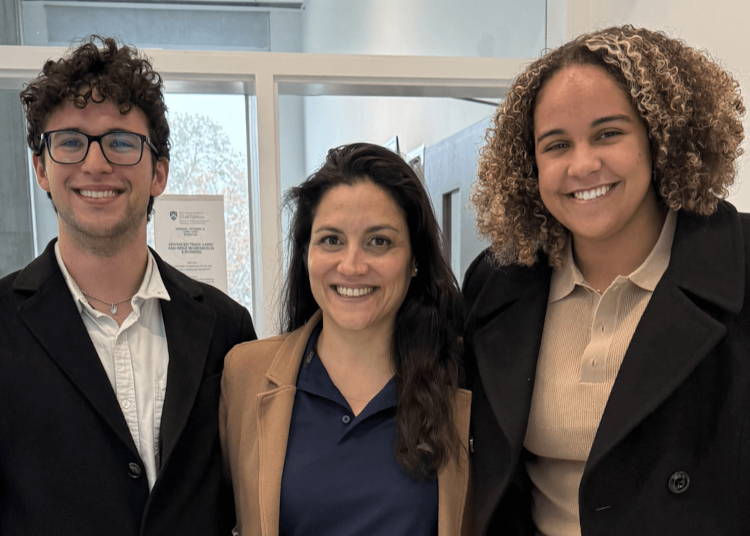
“Sport law is not a future pursuit, but a present opportunity,” Moise says. “Students don’t need to wait for law school or permission to engage seriously with this field.”
Looking ahead, Moise plans to attend law school and pursue a career in sport law, with a focus on athlete advocacy, representation, and equity. She is currently developing new research examining the exclusion of service academy athletes from NIL opportunities.
“Above all, this experience clarified my commitment to opening doors for others,” Moise says. “When students are trusted with real responsibility early on, their work begins to speak for itself.”
Sergio Rojas, a senior from Houston, is double majoring in Business with a concentration in Finance and Sport Management with a concentration in Leadership.